5 Layers to Perfect Before AI Recommends Your Dental Practice
We’ve started a dedicated AEO/GEO test team to figure out exactly what gets a dental practice cited by AI. First thing we’ve figured out? Order matters more than effort.

Picture a potential patient opening ChatGPT and asking for a good dentist nearby who does implants. Maybe they’ve gone to Google instead and ask the same question, and then read the AI summary at the top without scrolling to a single website. However, they’re getting their answer; something new is now deciding whether your practice gets mentioned. It’s not another patient, and it isn’t quite Google either.
AEO is all the rage right now, and no matter how many LinkedIn posts or Meta ads you see punting an AI program that has it all figured out, there are a lot of unknowns about how to effectively get cited in AI search results. That’s why we’ve formed a special AEO/GEO test team, who will spend the next several weeks testing how that decision gets made on real dental practices we work with.
We’ll be sharing the results as they come in, including the tests that go nowhere. But before any of that, there’s a piece of groundwork worth laying out, because almost every conversation about “AI visibility” skips it.
There are five foundational things that we believe to be true before AI will cite your practice, and according to our research, they have to be done in order. If the first one fails, the effort you put into the fifth is invisible.
What many marketing experts are getting backward
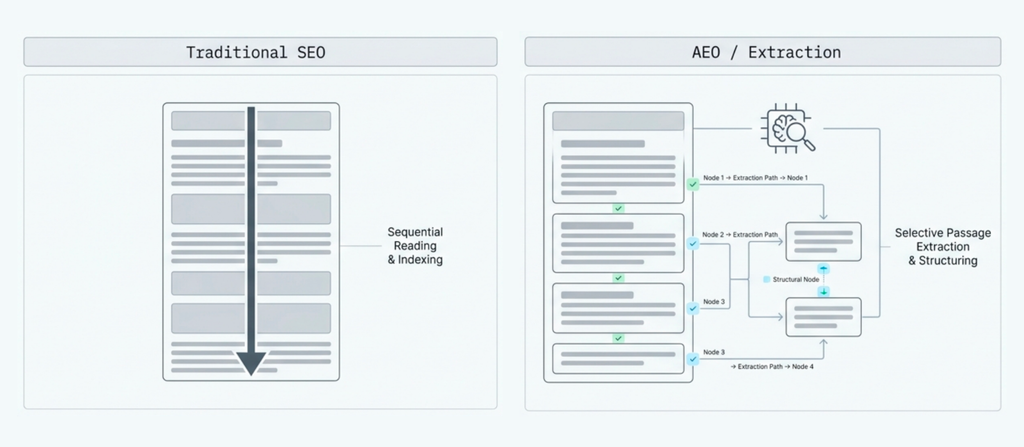
An AI model doesn’t read your website the way a patient does. It doesn’t land on your homepage, get a feel for the place, and browse around. It sends an automated crawler to pull what it can, extracts the pieces it can cleanly understand, and decides, piece by piece, whether to trust you enough to repeat that information.
That means the whole game is access first, meaning second, trust last. In that order. The five layers we’ve identified are founded on this idea. Though remember that AI is growing and evolving every day, so these aren’t hard rules; they’re just the framework for what’s solid right now.
Layer 1: Can the crawler reach you at all?
AI crawlers are automated visitors. If your website’s settings turn them away with a robots.txt file that blocks them, a security setup that mistakes them for a threat, or a sitemap that’s out of date or points to pages that no longer exist, they will leave without reading anything.
When that happens, nothing else in this list applies. You can have the most trustworthy, best-structured content in your city, and it’ll mean nothing, because the thing that would have cited it never got through the door.
Layer 2: Once inside, can it actually read the page?
Say the crawler gets in. The next question is whether it can read your content before it gives up.
Crawlers don’t wait around. If a page loads slowly, or if scripts and tracking code load ahead of the actual content, the crawler can move on before your words ever appear. The measure that matters most here is how quickly the page starts delivering real content, and while we’re still testing exactly where the cutoff sits, the direction is clear: faster is materially better, and slow pages lose out.
Layer 3: Can it understand what it’s reading?
Now the crawler can reach the page and read it. Can it tell what the content actually means?
This comes down to how the page is built underneath the words. A page assembled from a mess of anonymous, nested design containers forces the machine to guess which part is the heading, which is the main answer, which is a footnote. Guessing is where wrong answers come from. A page built cleanly tells the machine plainly what each part is, so it can lift the right passage easily.
You don’t need to know the technical terms for any of this. You need to know that “it looks fine on screen” and “a machine can understand its structure” are two different tests, and the second one is the one AI is running.
Layer 4: Can it verify your facts?
This is where structured data earns its keep. And for dental practices that rely on local visibility, it matters even more.
Schema is a small, standardized block of information that hands a machine your name, address, phone number, hours, and services in a form it doesn’t have to interpret. When it’s present and correct, the machine doesn’t have to go hunting for your details across the web and hope it finds the right ones. When it’s missing or broken, it goes looking elsewhere.
We’ve watched an AI confidently give a patient the wrong detail about a practice because it pulls a fact from an unrelated business on the other side of the world, simply because the practice’s own site never stated the right one clearly. A gap in your information isn’t read as a gap. It’s read as an invitation to fill it, and the machine will fill it with whatever it finds.
Layer 5: Does it trust you enough to repeat you?
Everything to this point gets your content readable and understood. This layer is what tips a citation toward you rather than the other practice saying the same thing.
Some of this is basic and non-negotiable: a valid, current security certificate on your site, so it reads as safe rather than suspect. Signals that connect your content to real, verifiable people and organizations, so the machine can see that a named practice and a named dentist stand behind it, is also incredibly beneficial. On its own, this layer won’t save a site that fails the ones below it. But between two practices that are otherwise even, it can be the tiebreaker.
Why the order matters so much
It’s tempting to jump to layer four or five, because schema and authority sound like complicated work. But a practice blocked at layer one gets nothing from perfect schema, the same way a beautifully verified fact is useless if the crawler timed out on a slow page. The value is in fixing them from the bottom up.
That’s also how we’re auditing it in the AEO/GEO tests we run. Rather than a vague sense of “good” or “bad,” each layer can be scored, so a practice can see exactly where it’s losing citations rather than guessing.
What this means for you right now
You don’t need to action all five layers this week, and you don’t need to become technical to benefit from any of this. What’s worth doing today is smaller. Recognize that AI recommendations are already happening for practices like yours, and that they run on things many dental websites aren’t optimized for.
Over the next few weeks we’ll be publishing what we find as we test each layer on live accounts, from what moves citations, what doesn’t, and where our own assumptions turn out to be wrong. If you’d rather not run the experiments yourself, following along is the shortcut.
And if you want to know how your own site currently sits against these five layers, that’s exactly the kind of thing we can walk through with you. Book a call and we’ll go through it together.